Why living walls die, and what it costs to bring one back
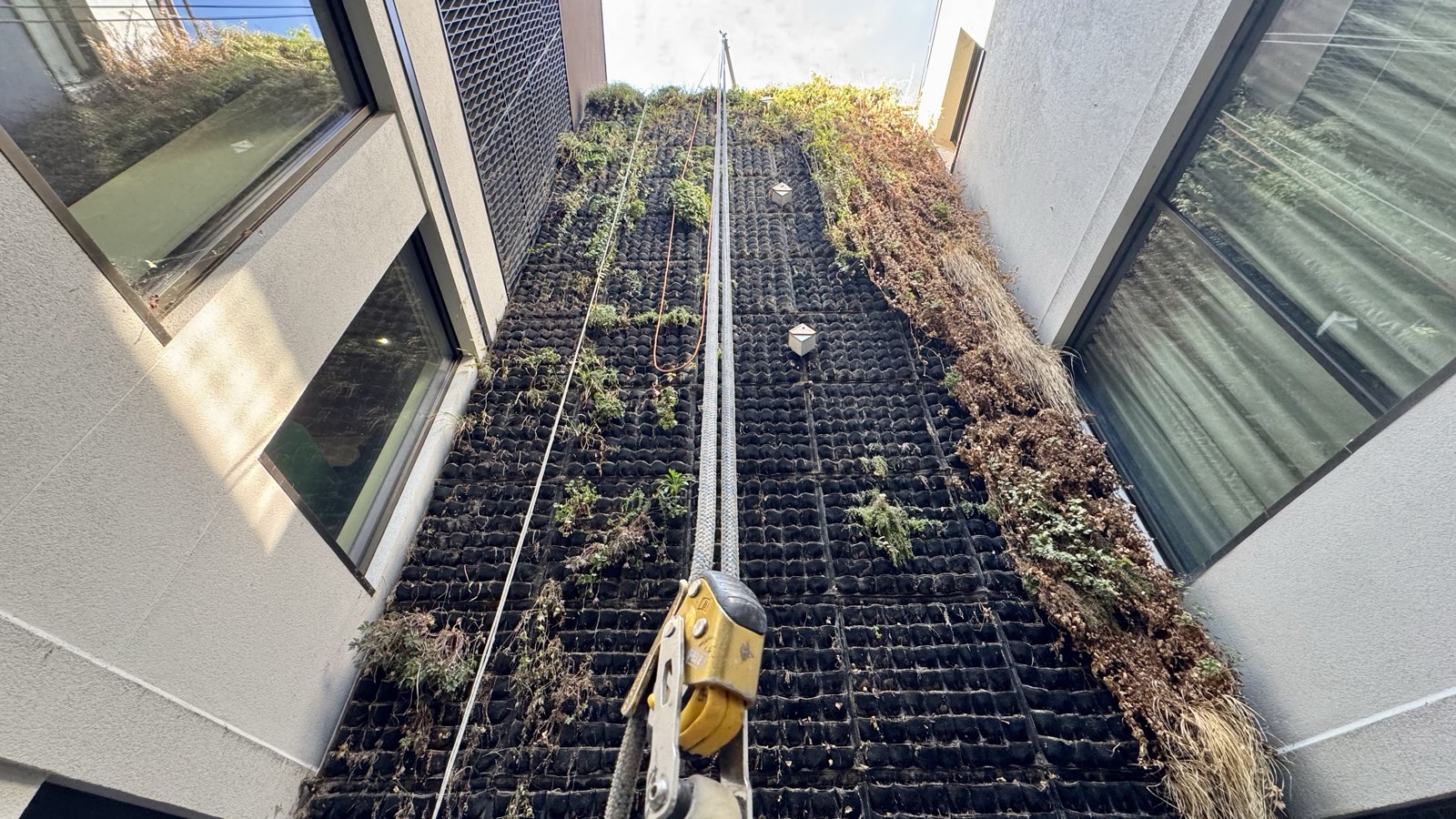
A living wall is the only part of a building that dies if you ignore it. Brickwork weathers, render cracks, gutters block, and all of it takes years. A green wall goes brown in a single hot fortnight if a pump fails, and once the planting is gone you are not cleaning something, you are buying it again.
The photograph above is a wall we were called to in a London lightwell. Look at what it tells you: the modular planting cells are intact, the structure is sound, the irrigation line runs where it should. Most of the plants are dead anyway. That is the typical failure, and it is almost never the wall's fault.
What actually kills them
The irrigation fails quietly
Every living wall depends on a pump and a network of drippers. A dripper blocks, or a pump trips, and nothing announces it. The wall looks fine for a week. By the third week in July the top two rows are gone, because the top of a wall dries first and hardest.
Nobody can reach it
This is the real cause behind the first one. Living walls are specified on tall elevations and in narrow courtyards, precisely the places you cannot put a ladder, a tower, or a cherry picker. So the maintenance contract quietly becomes "look at it from the ground", and looking at it from the ground tells you nothing about a blocked dripper on the fifth row.
The planting was wrong from the start
A north-facing lightwell gets an hour of direct sun and a lot of wind funnelling through. A south elevation bakes. Specify the same species list for both and one of them fails within two seasons, whatever you do with the water.
The growing medium runs out
Modular systems hold very little substrate by design, because weight matters on a facade. That substrate is exhausted within a few years. A wall can be watered perfectly and still thin out because there is nothing left to feed on.
What it costs to bring one back
It depends almost entirely on one question: is the irrigation still sound? If it is, recovery is a replanting job. Access, strip the dead stock, test and flush the lines, replant the failed zones, feed, and report. If the irrigation has failed structurally, or the panels themselves have degraded, the numbers change, because now you are replacing the system rather than its contents.
That is why we survey before quoting. Two walls that look equally dead from the pavement can be a fortnight apart in work and several times apart in cost.
The part that actually saves money
Planned maintenance on a living wall is cheap relative to what it protects. Two or three visits a year, with an irrigation check before summer, catches the blocked dripper while it is still a blocked dripper. The alternative is discovering it in September, when the only fix is new plants.
If you have a wall that is browning, or one you have simply never been able to inspect, send a photo and the address. We will tell you whether you are looking at a maintenance visit or a recovery, and we can quote both.