Cleaning a rooftop solar array you are not allowed to walk on
Every solar cleaning company shows you the same photograph: a panel cut down the middle, filthy on one side and gleaming on the other. It is a good photograph. It also answers a question nobody with a commercial roof is actually asking.
If you look after an industrial building with a few hundred panels on it, you already know the glass gets dirty. What you do not know is how anyone is going to reach it without putting a boot through your roof.
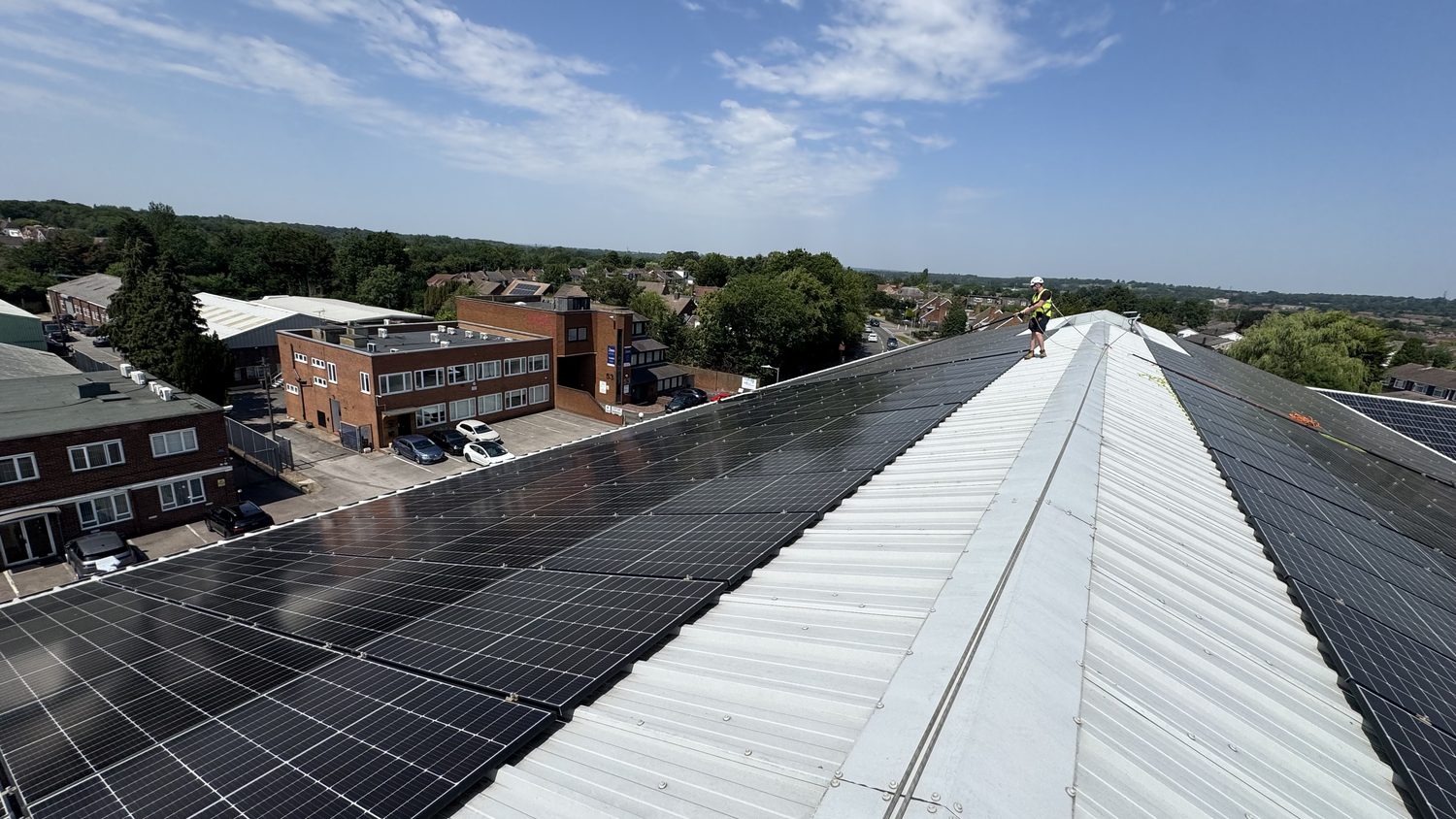
That is the roof this article is about: a commercial estate in Borehamwood, Hertfordshire. Profiled metal sheet, a long ridge, and an array laid to fill both slopes. It is a completely ordinary British industrial roof, and it presents every access problem there is.
Why you cannot simply walk up and clean it
The panels are not a floor
A solar module is a sheet of glass over silicon cells. Standing on one can crack the cells beneath it without leaving a mark on the glass. You will not see the damage on the day, the client will not see it on handover, and it does not heal. It shows up later as a string that underperforms for the rest of its life.
The roof underneath is fragile
This is the one that hurts people. Falls through fragile roof materials remain one of the most common causes of death in UK construction. Profiled sheet is fragile once it has aged, and a weathered rooflight can be almost indistinguishable from the sheet next to it, especially when both are under a layer of dust and an array is casting shadows over everything.
The machine does not reach
A powered access platform is the obvious answer and usually the wrong one. Even where there is hardstanding to set one up, it will not reach the middle of a roof whose array runs all the way to the ridge. You can clean the first two rows beautifully and nothing else.
What we actually do instead
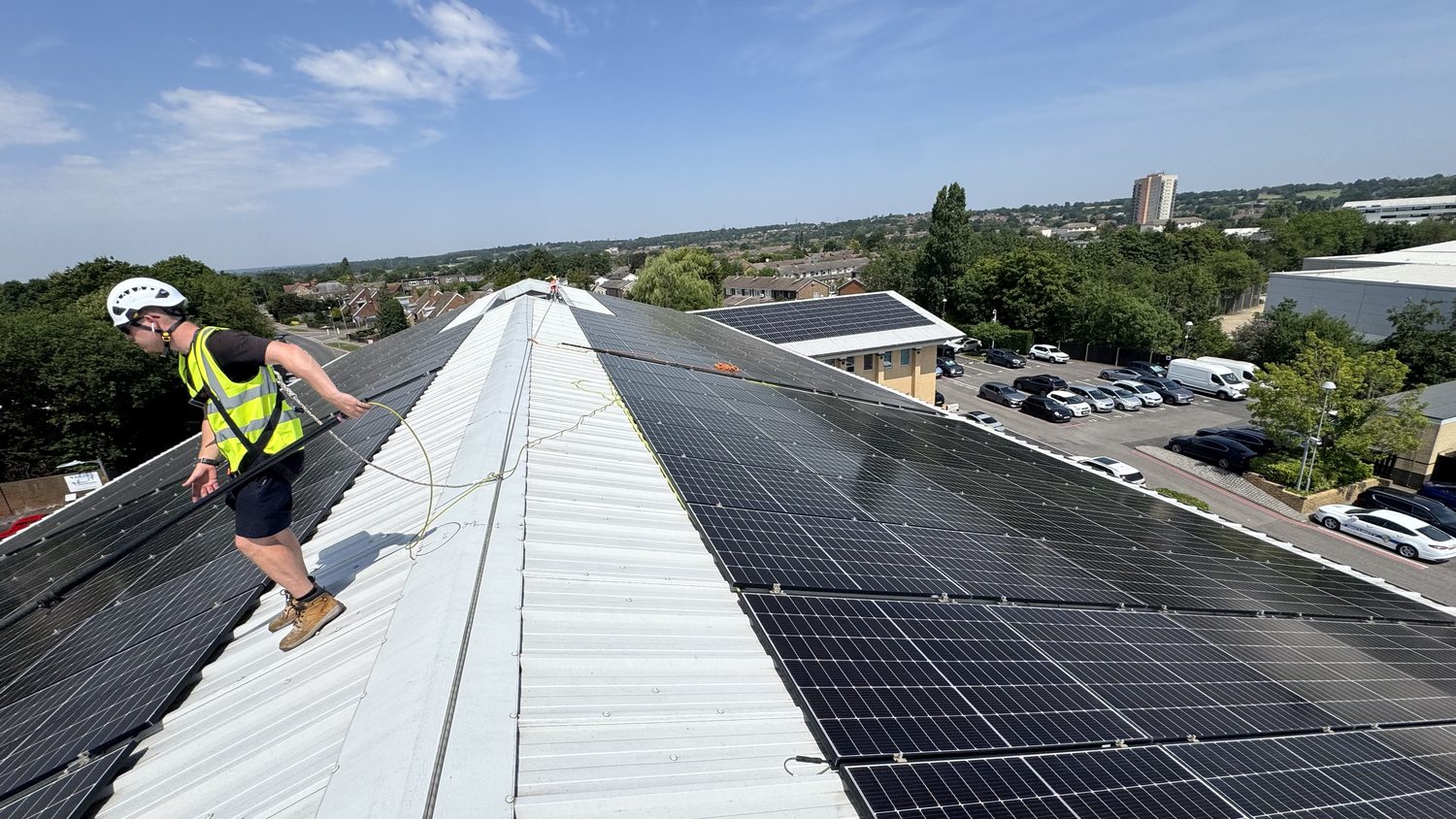
The method follows from the constraints. If the array cannot be walked on and the roof cannot be trusted, then the operative stays on a known safe line and the equipment does the travelling.
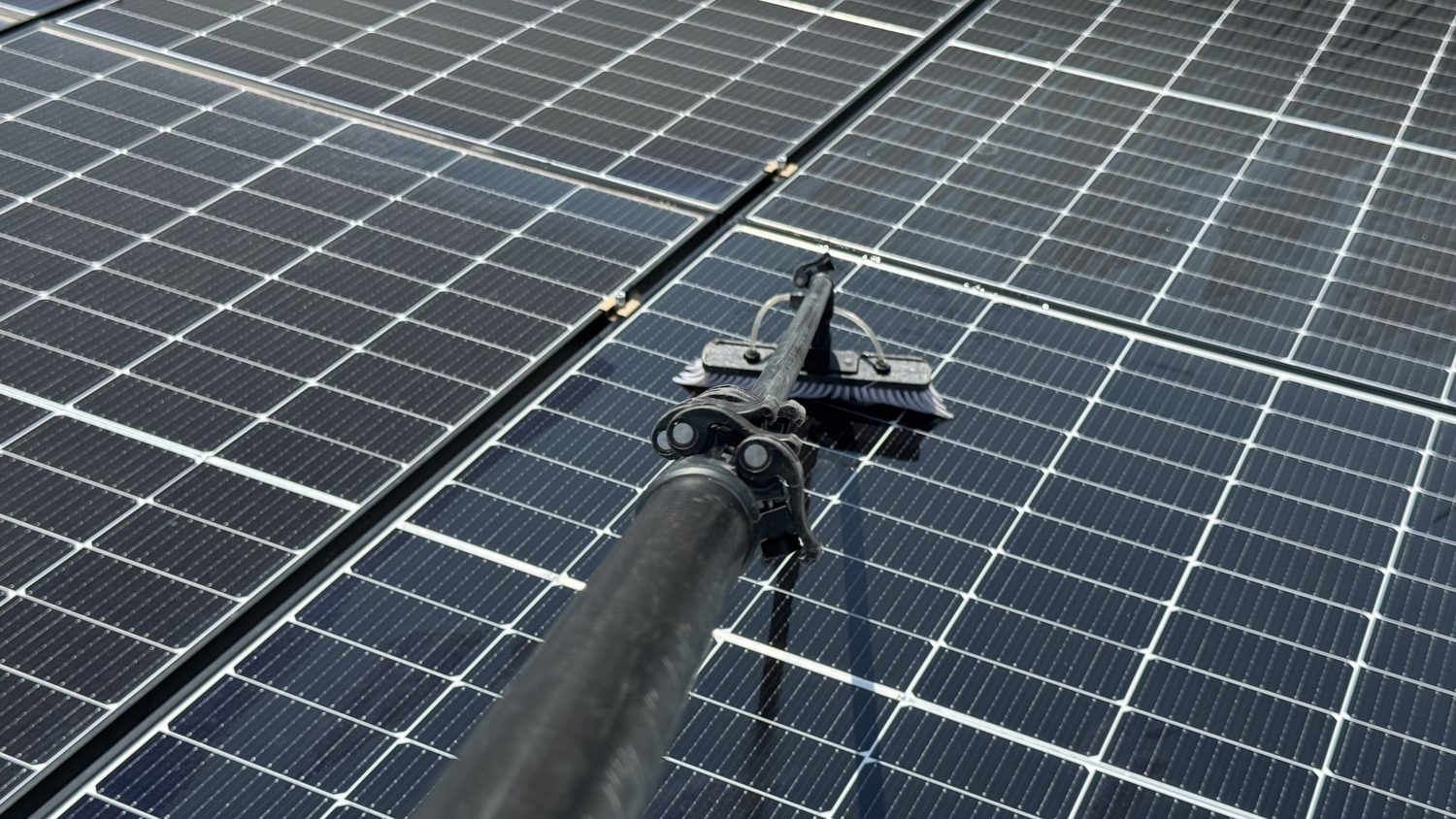
We assess the roof before anyone is on it: construction type, anchor points, fragile areas and every rooflight. Then operatives work from the ridge and the safe zones, attached throughout, and reach across the array with telescopic water-fed poles. The brush touches the panels. The technician does not.
Pure water, and nothing else
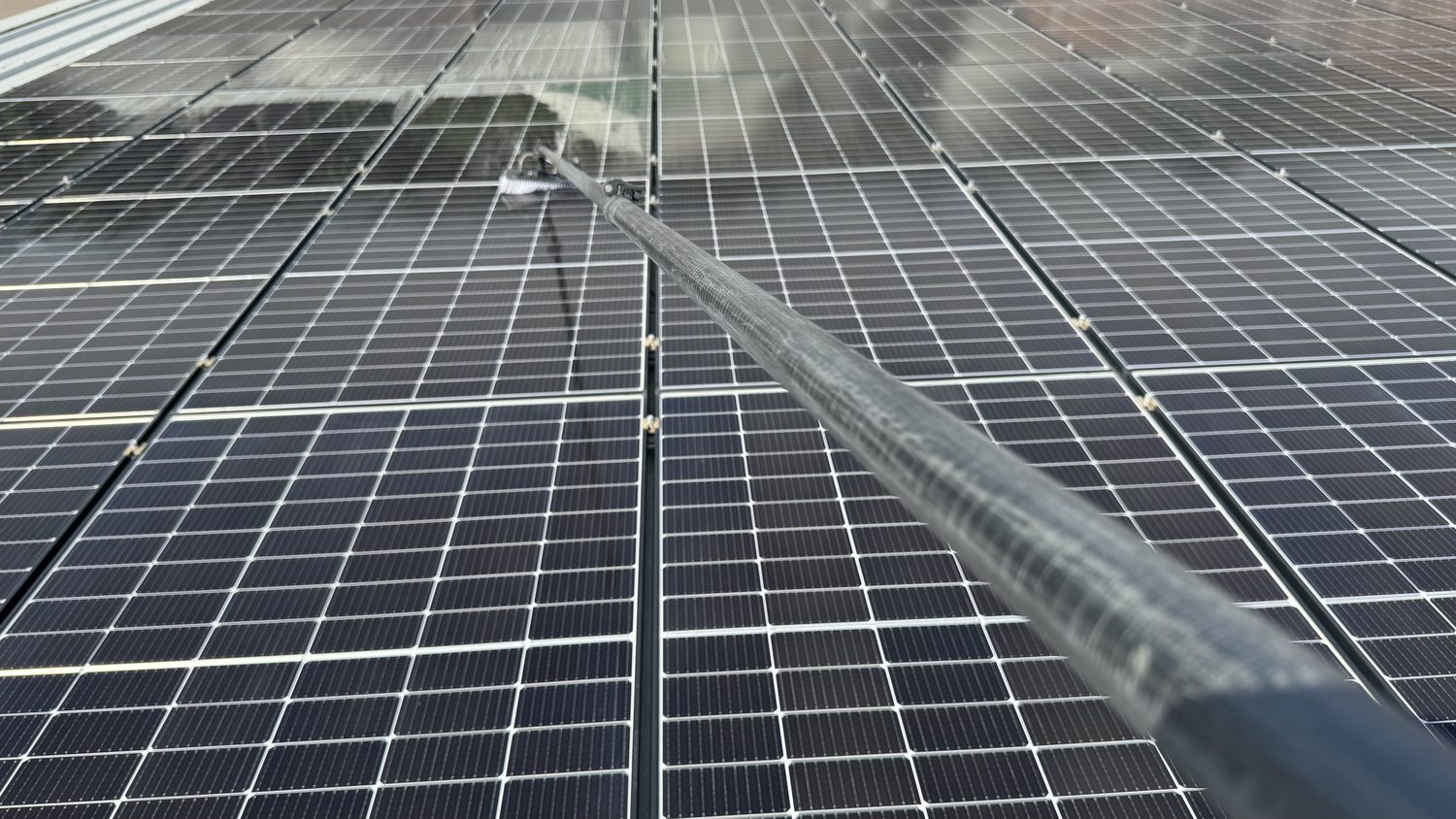
We clean with deionised water and a soft brush. No detergent, no abrasive, no pressure washer.
That is partly about the panels. High pressure can drive water past the frame seals, and most manufacturers will treat pressure washing or chemical cleaning as grounds to refuse a warranty claim. But it is also about the result. Ordinary water carries dissolved solids, and when it evaporates it leaves them on the glass as a film that then attracts more dirt. Strip those solids out and the water dries off the panel leaving nothing at all behind.
It is also, incidentally, why rain is not a cleaner. Rain moves dust around a panel and evaporates. The reason arrays develop a band of silt and moss along the bottom frame is that the water always ends its journey in the same place.
The part that is worth more than the cleaning
Somebody is on your roof, at close range, looking at every panel in the array. That does not happen often, and it is the best defect survey you will get all year.
What we photograph while we are up there: cracked or crazed glass, discoloured or browned cells, delamination at the laminate edge, clamps that have worked loose, cabling chafing on the sheet or hanging into standing water, vegetation seeding in the gutters, and gutters that are blocked under the array where nobody has looked in years.
Those findings often matter more than the clean itself, because a loose clamp on an exposed roof is a panel waiting to become airborne, and a blocked gutter under an array is a leak nobody will trace for a year.
How to tell whether yours is due
You almost certainly have better information than any contractor's estimate. If your inverter or monitoring platform records per-string output, compare this summer against the last one on comparable days. A gradual decline across all strings is soiling. A single string dropping away is a fault, and worth looking at before it is worth cleaning.
Most commercial roofs suit an annual clean. Twice a year makes sense next to trees, a farm, a busy road, a dusty industrial process, or a gull colony.
If you have an array you have never been able to inspect, send the postcode and roughly how many panels are up there. We will tell you what the access looks like and what it would cost, and we cover Hertfordshire and the home counties as well as London.
Related: solar panel cleaning, gutter cleaning, and roof surveys and condition reports.